
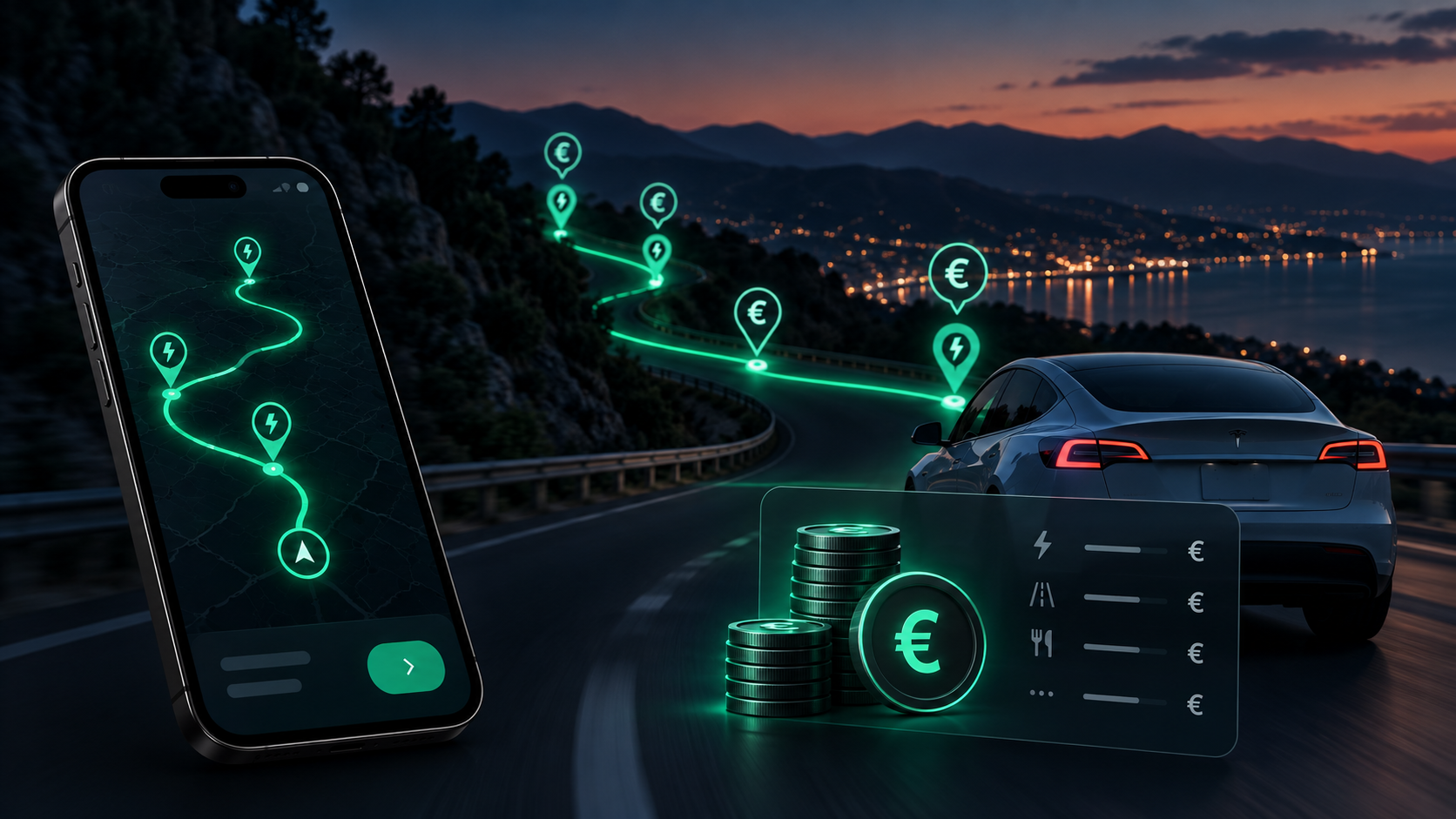
You open EVStick and see two numbers: what it cost you to drive today, and what it cost this month. They look effortless. €1.46. €15.97.
But "how much does it cost to drive an electric car" is a surprisingly hard question. Harder than it sounds. And the way EVStick arrives at those numbers is maybe the most interesting thing happening under the app's hood.
Here's the whole story.
The naive answer (and why it's wrong)
Everyone's first instinct is simple: take the kilowatt-hours the car used, multiply by the price of electricity, done.
The problem is the phrase "the price of electricity." Which price?
The energy in your battery right now didn't come from one place at one price. Some of it you charged at home last night, on the night tariff, for pennies. Some you topped up at a fast charger on the motorway last week — at five times the rate. And some was in the pack when you bought the car.
When you pull away today, which of those are you spending? The cheap home energy or the expensive motorway energy?
The answer is: a blend of all of it. And that blend is exactly what EVStick tracks.
The battery as a warehouse
The model underneath is borrowed from accounting — it's called weighted-average inventory costing.
Picture the battery not as a tank of electricity, but as a warehouse. Every charge is a delivery of stock into the warehouse — at a certain price. Every drive pulls stock out to consume it. The question "what did this drive cost" is really the question "what was the average price of the stock I pulled out."
The key insight: EVStick doesn't track what electricity costs today. It tracks what it cost to fill this particular battery — charge by charge — and how much of that you spend each time you drive.
The currency is percent, not kilowatt-hours
First surprise: internally EVStick counts everything in battery percentage points, not kilowatt-hours.
The reason is practical. The car reliably reports one thing every few minutes — the battery level in percent. The exact kilowatt-hours used on a given drive we don't know for certain (Tesla doesn't expose it in a way we can rely on for every trip). So the currency of the whole model is one percentage point of battery.
Every point in the warehouse has its own price — say "3.5 cents per point." Charge, and you add points at their price. Drive, and you spend points at the average price. Simple, robust, and it doesn't depend on a number we don't have.
(Kilowatt-hours do show up eventually — the app learns how many kWh a point represents from the charging sessions themselves, but only to show you energy in familiar units. The maths doesn't need them.)
How a charge gets priced
Every time you finish charging, EVStick has to answer one question: at what price did this energy arrive?
The answer comes from two things the session already carries — where and when you charged:
1. If you're at a known public station — the price is that network's published tariff. Eldrive, Electrip and the others publish their rates; the app knows them and uses them directly. Within about 100 metres of a catalogued station, that's the charge.
2. If you're nowhere near a station — we assume you charged at home. And here's where it gets clever: EVStick figures out your electricity price on its own, without you entering it.
From the GPS coordinates of the charge, the app works out which Bulgarian distribution territory you're in — Electrohold (west), Electrohold South (former EVN), or EnergoPro (north-east) — and takes that region's regulated day or night tariff. Charged between 23:00 and 07:00? Night rate. Otherwise, day rate.
This is a deliberate decision: nobody should have to go find their own €/kWh rate and type it in for a number the app can estimate for them.
When nothing can be pinned down — a public station with no published price, or a charge the car never reported a position for — EVStick falls back to a reasonable assumption (like an average fast-DC rate), but marks the whole tally as an estimate from then on. It never invents a €0.
The weighted average — with real numbers
Here's where the warehouse comes alive. Let's follow a real scenario.
Last night, at home, on the night tariff. You charge 40 points. Say it cost you €1.40. The warehouse now holds 40 points, each priced at €0.035 (€1.40 ÷ 40).
This morning you drive to work. You spend 15 points. The cost of that drive:
15 points × €0.035 = €0.53
The important bit: spending doesn't move the average. The warehouse is now down to 25 points, each still at €0.035. That's why parked drain between drives needs no bookkeeping of its own — it just leaves fewer points at the same price.
At lunch you top up at a fast charger. 20 points, but at €4.60 — motorway pricing. Now the warehouse blends the old cheap stock with the new expensive stock:
(25 old points × €0.035 + €4.60) ÷ 45 points = €0.122 per point
In the afternoon you drive again and spend 10 points:
10 × €0.122 = €1.22
See what happened? The exact same 10-point drive costs a different amount depending on what blend of energy fills your battery at the time. Just like in real life.
How a drive "spends" from the warehouse
One question remains: how many points did the drive actually spend?
EVStick measures this two ways:
If the battery drop is big enough (at least 3 points), that's the truth — it's exactly what left the pack, climate, hills and traffic included. We take the real drop on the gauge.
If the drop is too small to measure — this is the subtle part. The battery gauge resolves to whole percents. A 4-kilometre errand to the shop often reports as "zero percent drop." If we priced those drives at €0, it wouldn't read as "too small to measure" — it would read as free motoring, and quietly halve the monthly total you're checking against your electricity bill.
So for short drives EVStick uses the distance covered, converted into points at your own learned consumption — how far you go on one point, which the app learns from your own trips. A number like that gets marked as an estimate.
That's why it always says "≈"
You may have noticed every number carries the ≈ sign — "approximately."
That's not modesty, it's honesty. A station's tariff can vary by membership plan. "Not near a station" isn't proof of "at home." The regional electricity rate is an estimate, not your actual bill. And short drives are computed, not measured.
EVStick would rather give you an honest estimate — one that lands strikingly close to reality — than false precision down to the cent. The number is good enough to answer the question you actually care about: is it worth it to drive this car, and by how much?
There's a third number that makes the estimate comparable: cost per 100 kilometres. It turns "€15.97 this month" into something you can set next to a petrol car's running cost and see the gap instantly.
What you have to do
Nothing.
There's no field to enter your electricity price. No tariff setting. We won't ask which distribution region you live in. All of it is derived on its own — from data the app already collects to show you the battery and plan your routes.
You drive, you charge, you live your life. EVStick quietly keeps the books, so that when you glance at the dashboard, the number is simply right.
This is also why sharing your cost means something: when you show a friend "I drove 141 km this month for €15.97," there's a real ledger behind that number — not a marketing round figure. See what your Tesla really costs with EVStick.